
Pearland Directory Collections
Pearland's historical directory record is distributed across regional, state, and library collections. The catalog evidence supports a Greater Houston telephone series that includes Pearland and Brazoria County locations. It does not establish that a complete, separately published Pearland run sits at a local branch. Use the regional run as a dated address lead, then ask a librarian or repository about a named year and publisher. That approach keeps a useful collection from being overstated.
| Collection | Years | Where held | Access |
|---|---|---|---|
| Greater Houston Residence White Pages, Southwestern Bell/SBC | Listed runs, 1956-2005 | UT Austin Center for American History | Catalog record; confirm onsite or reproduction rules |
| U.S. historical directories | 1822-1995, publisher varies | TSLAC and Ancestry onsite; HeritageQuest and library routes | Search by city and year; local Pearland shelf run is unverified |
| Library of Congress historical directories | 1861-1960, city dependent | Library of Congress digital and reading-room collections | More than 1,200 cities, with gaps and varied arrangements |
| BCLS Ancestry Plus and HeritageQuest | Coverage varies; HeritageQuest census 1790-1940 | Brazoria County Library System branches | Library-only or credential-dependent access may apply |
| UNT Portal to Texas History | Digitized items vary by title and year | Online Portal to Texas History | Search names, place, date, subject, title, and full text |
The Brazoria County Library System genealogy and history collection supplies the local starting point for licensed databases, FamilySearch, maps, and reference help.
BCLS does not publish exact Pearland city-directory years, a named local publisher run, an obituary-index span, or a reverse-directory inventory in the inspected official material. Treat those as questions for staff, not as assumed holdings.
The Verified Pearland White-Pages Bridge
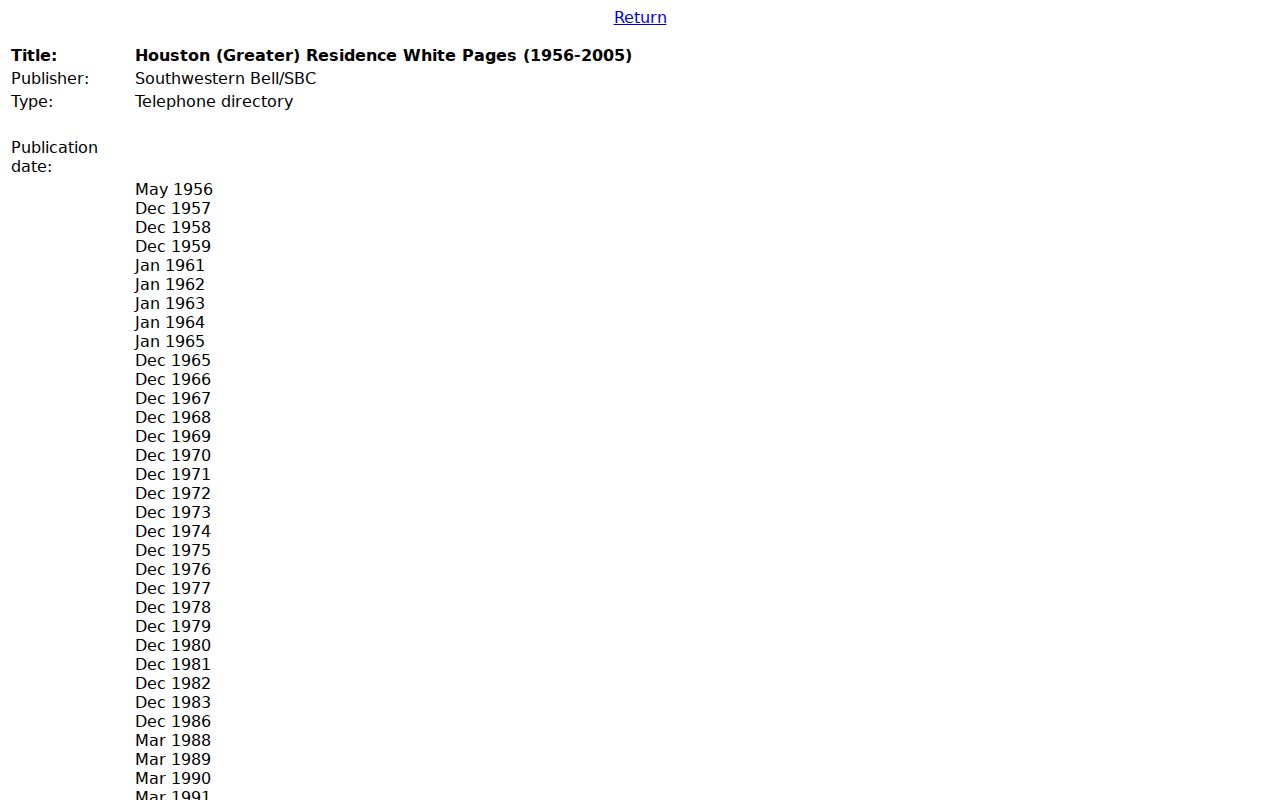
UT Austin’s Center for American History catalogs Houston (Greater) Residence White Pages, a Southwestern Bell/SBC series that names Brazoria County and Pearland among its locations. The cataloged dates are May 1956; December 1957-1959; January 1961-1965; December 1965-1983; December 1986; March 1988-1997; March 1999-2001; and March 2004-2005. This is the strongest verified postwar address and subscriber bridge for Pearland research.
The Greater Houston Residence White Pages catalog record identifies the series and its location coverage.
A listing can support a dated subscriber or address hypothesis. It is not proof that every Pearland household appeared, and it should not be relabeled as a complete municipal city directory. Save the edition, page, city or area label, and exact street spelling before testing the address against a parcel, deed, census, or cemetery source.
Pearland Directory Research at BCLS
For a specific local question, ask for the exact year, publisher, street, and type of item needed. Tom Reid Library is at 3522 Liberty Drive, with a reference route and regular hours listed as Monday through Wednesday from 10 a.m. to 9 p.m., Thursday through Friday from 9 a.m. to 6 p.m., and Saturday from 10 a.m. to 6 p.m. The official branch directory lists 281-652-1677 and pearland@bcls.lib.tx.us. West Pearland Library is another BCLS branch at 11801 Shadow Creek Parkway.
Genealogy material and microfilm may not travel through interlibrary loan, so an onsite visit or a staff-mediated copy request may be necessary. Ask whether a particular white-pages edition, newspaper reel, yearbook, obituary index, or criss-cross directory is held. A general request for a list of local people cannot replace a request for an identified historical source. Note: Record the librarian’s answer with the collection name and the date because local access conditions can change.
Texas Directory Routes and Gaps
Texas State Library and Archives Commission explains the broad historical-directory route: its onsite Ancestry access includes U.S. directories for 1822-1995, and it points researchers to HeritageQuest, WorldCat, the Library of Congress, UNT, and reference help. The collection can contain a name, address, telephone number, spouse notation, printed role, and an edition-specific status mark. The presence of a field varies by volume.
The TSLAC city-directory guide explains the state archive route and related research paths.
TSLAC is also a fallback after a local lead runs out. Its Brazoria microfilm inventory reaches deed records beginning in 1837, marriage material from 1829, probate from 1837, and tax rolls from 1837. A directory omission should prompt a search of the right archive or county record, not a conclusion that the person was absent.
The Library of Congress city-directory guide describes a separate U.S. collection arranged by city, with alphabetical, address, and telephone forms depending on the item.
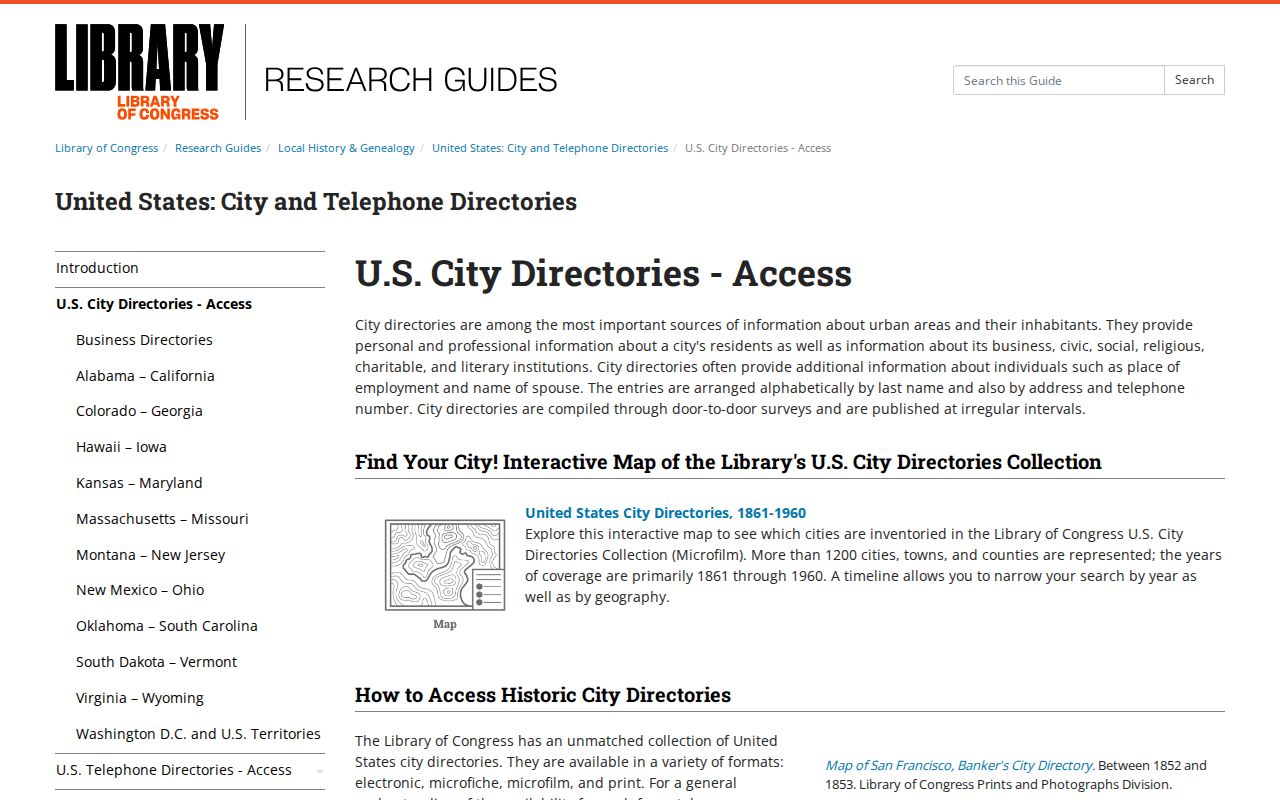
The Library of Congress material covers more than 1,200 cities from 1861 through 1960, but it has gaps. A Pearland result may instead be grouped with a larger Houston-area volume, or no local title may appear at all. That is a documented collection limit, not a reason to fill the gap with an unsupported shelf claim.
Read a Pearland City Directory Entry
Read an entry as a set of edition-specific clues. A telephone book often emphasizes the subscriber and number, while a historical volume may add a street address, spouse notation, printed role, or a cross-reference. The exact abbreviation key belongs with the entry. Capture the volume, date, page, repository, and whether the result came from an alphabetical or address-ordered section. Never assume that a missing field was intended to be complete.
| Name | Surname and given name or initials as printed. |
|---|---|
| Household notation | Spouse or other notation, often in parentheses when the edition uses it. |
| Printed role | A business or role field, only if that volume includes one. |
| Address | Street number, street, and any printed apartment or unit detail. |
| Telephone | Exchange and number in a telephone directory when printed. |
| Edition mark | An abbreviation, widow notation, or cross-reference mark where the volume defines it. |
| Citation | Alphabetical or address page, edition, repository, and page number. |
- Criss-cross section
- An address-ordered part of a directory, when included, used to test who was listed at a street location.
- Householder index
- An index organized around the named household listing rather than a current public roster.
- Abbreviation key
- The edition’s own explanation of symbols and shortened words. Photograph or copy it with the page.
Marks can change between publishers and years. An h, r, wid, apt, or telephone exchange should be transcribed as the volume uses it, then checked against the volume’s own key before drawing a family-history conclusion.
Pearland Addresses in Criss-Cross Pages
Address-ordered or criss-cross pages are the strongest directory form for a historic street question. Start with the exact street spelling used in the edition, work through house numbers in order, and preserve every relevant page reference. A white-pages result can then be compared to a parcel or deed description. If a street is absent, test a nearby cross street, a rural route, a subdivision name, a railroad reference, or the wider county label.
Directory coverage creates normal false breaks. Unlisted telephone service, a rural-route address, a different mailing label, a changed street name, and the publisher’s chosen coverage area can each remove a listing. The reverse pages are a research lead rather than a complete record of all people at an address. For current parcel and recorded-instrument work, use the Street Directory rather than stretching a historic edition beyond its date.
UNT Place Anchors for Pearland Directories
Maps, marker applications, school material, and newspapers can stabilize an address when a historical volume gives only a short street name or a changing place label. UNT’s Portal to Texas History supports full-text, metadata, title, subject, creator, name, location, date, and resource-type filters. The Pearland quadrangle and a 1999 Pearland High School historic-marker application demonstrate the kind of local place context that can be searched there.
The UNT Portal to Texas History provides the filters used to locate those Pearland context records.
These records are not household rolls. They are useful for fixing an institution, street name, map date, or historic owner in time before the next directory, deed, or census search. Keep the catalog record with the directory citation so the location link remains clear.
Pearland Cemetery Research after Directories
A directory trail often needs a human-assisted endpoint. The Brazoria County Historical Museum research center holds people, place, photographic, and cemetery resources. Its cemetery database covers more than 23,000 interments in 140 county cemeteries. The former Old 300 database was removed from the web for privacy, but staff continue to answer cemetery and genealogy questions by email at research@bchm.org or by phone at 979-864-1208.
The Pearland Historical Society is another local-history contact for Old Town, photographs, oral-history leads, and institutional context.

The society publishes contact and meeting information, not a member directory. Ask for a specific person, place, time period, or type of historical record. Old Settler’s Cemetery can also anchor a family trail: the city describes it as the main community burial ground until 1936, with pioneer and veteran context, though no city-hosted interment search was located.
Pearland Directory Time Markers
A short timeline helps place an entry in the right local setting. It does not turn a directory into a complete resident roll, but it can explain why the same parcel appears under county, rural, or later Pearland geography.
| 1894 | The Pearland townsite was platted at the Brazoria courthouse. |
|---|---|
| 1917 | Telephone lines arrived in Pearland, a useful context point for telephone listings. |
| 1956 | The first cataloged Greater Houston Residence White Pages run begins. |
| 1959 | Pearland incorporated, changing the municipal context of later records. |
| 2005 | The last cataloged Greater Houston white-pages run in the verified series appears. |
The federal census adds fixed comparison points. The released decennial years available for this work are 1900, 1910, 1920, 1930, 1940, and 1950. Census addresses are not always exact, so use street order, nearby names, and the enumeration district with a dated directory entry.
Trace Pearland City Directory Families
A careful Pearland directory trail moves across years and record types. Start with the latest permitted edition in the relevant run and work backward. A vanished listing can mean a move, a changed subscriber name, an unlisted number, a rural route, a coverage gap, or a death. It is not proof of a single event without a second source.
- Find the latest relevant white-pages or historical-directory entry and preserve the edition, page, area label, and exact street spelling.
- Move backward through the identified run, recording address continuity, household notation, printed-role changes, telephone changes, and cross-references.
- Pair the dated listings with the 1900 through 1950 federal census releases, using street order and nearby names when the address differs.
- When the directory trail stops, test the address with a deed or grantee record, tax roll, marriage or probate material, cemetery source, obituary lead, or the appropriate census.
- Ask BCLS, the Museum, the Historical Society, or TSLAC for the exact year and publisher before describing another Pearland directory run as held.
That record-by-record method supports family history without pretending that a historical listing proves every fact about a household. The best citation includes the volume, edition year, page, repository, search date, and any access limit encountered.